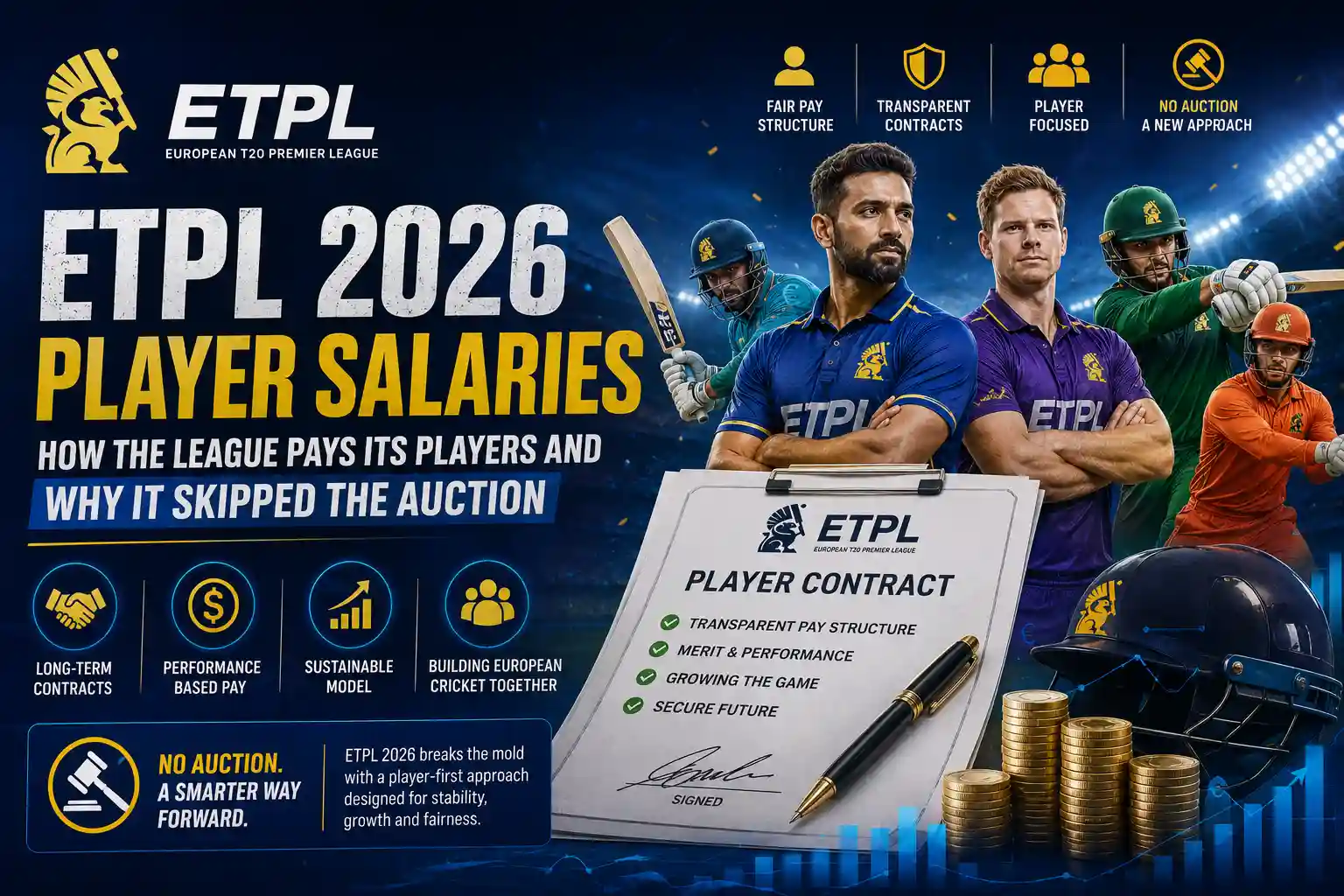
ETPL 2026 Player Salaries: How the League Pays Its Players and Why It Skipped the Auction
Most new T20 leagues copy the IPL’s playbook: a live auction, franchises bidding against each other, and a handful of players walking away with contracts worth many times more than the rest of the squad combined. The European T20 Premier League did the opposite. For its inaugural season, the ETPL built its entire local player pay structure around a fixed-price draft, creating a clear and consistent approach to ETPL player salaries no bidding, no surprises, and no team able to outspend another for the same player.
Draft, Not Auction
In an auction, a player’s price is set by demand — whichever franchise wants them most simply bids the highest. In a draft, teams take turns picking from the available pool in a set order, and once a player is selected, no other team can sign them. There’s no back-and-forth and no escalating price tag attached to a popular name.
The ETPL’s inaugural player draft ran on 2 July 2026, with all six franchises picking from a pool of 270 eligible cricketers across Ireland, Scotland, and the Netherlands. It followed a snake-draft format — the pick order reverses each round, so whichever team picked first in Round 1 picks last in Round 2, and so on. This keeps any single franchise from repeatedly getting first choice. The opening pick of the entire draft was decided by a random draw of lots, and each team was given five minutes per selection.
Over six rounds, the six franchises made 36 picks in total — six local players each — to fill out the domestic core of their squads. See how each franchise’s picks translated into a final roster on the ETPL teams page, including Amsterdam Flames, Rotterdam Dockers, and the other four franchises.
What Each Draft Round Actually Pays
This is the part that breaks most clearly from how the IPL or similar leagues operate. Instead of a bidding war setting the number, ETPL salaries are fixed purely by the round a player is picked in. Get picked earlier, get paid more — and that’s the whole formula:
| Draft Round | ETPL Player Salaries |
|---|---|
| Round 1 | USD $55,000 |
| Round 2 | USD $50,000 |
| Round 3 | USD $45,000 |
| Round 4 | USD $40,000 |
| Round 5 | USD $35,000 |
| Round 6 | USD $30,000 |
| Round 7 | USD $25,000 |
| Round 8 | USD $20,000 |
No franchise can offer a player more than what their round dictates, regardless of reputation or form. That rule produced one of the more talked-about outcomes of the entire draft: Paul Stirling, one of Ireland’s most established international batters, went in Round 4 to Belfast Wolves rather than Round 1 — a reminder that draft order isn’t only about salary, it’s also a straightforward signal of how deep the ETPL judged the talent pool to be across all three nations.
Team Budgets and Where the Rest of the Money Goes
Each franchise operates under a total seasonal salary budget of USD $1.48 million. Only part of that pool goes toward the draft-picked local players at the fixed round rates above — the larger share is set aside separately for signing marquee international stars, the players fans actually recognise from global T20 leagues.
Squad composition rules tie into this too. Every franchise can carry up to 12 total players affiliated with Cricket Ireland, Cricket Scotland, or the Dutch cricket board (KNCB), with 6 to 8 of those required to be local players. On matchday, each team must field 7 local players in the starting XI alongside 4 international marquee signings — so the fixed-pay draft picks aren’t a bench formality, they’re written into the core XI every single game. You can see how each team balanced this mix once fixtures get underway on the ETPL live score page.
Why Build It This Way?
For a brand-new league trying to establish credibility with players from its first season, a fixed pay scale removes a lot of the noise that comes with bidding wars. No team can lure a player away with a bigger offer, no player has to wonder if a rival franchise valued them more, and franchise spending stays transparent and predictable from the outset. It’s a very different bet from the IPL’s escalating auction economics — the ETPL is optimizing for trust and balance in year one rather than headline-grabbing bidding numbers. Fans wanting to see how that squad-building philosophy plays out can follow the ETPL match schedule as the season progresses.
Full team-by-team salary breakdowns aren’t public, since individual marquee contracts are negotiated privately rather than announced with a price tag. But the draft-round structure above accounts for the local core of every squad, and it’s a detail worth knowing if you’re trying to understand how ETPL franchises are actually built — not just who’s playing, but what the league’s whole financial model is betting on. For ticket pricing and match-going costs on the other side of the league’s economics, see the ETPL ticket buying guide.
For full team rosters and how each squad came together, see the ETPL team squads pages, track how it plays out on the pitch via the ETPL points table, and follow squad news and season storylines on the ETPL news and updates page.