
Why Doesn’t ETPL 2026 Have England or Wales Teams?
Scroll through the six ETPL 2026 franchises and one thing stands out if you know European cricket: there’s no London team, no Manchester team, nothing representing England or Wales at all. For a continent-wide T20 league, that might look like an odd gap. It isn’t an oversight — it’s the whole point of the league.
The League Belongs to Three Specific Boards
The ETPL isn’t run by a pan-European cricket authority sitting above all the national boards. It’s a joint venture between three specific organisations: Cricket Ireland, Cricket Scotland, and the Royal Dutch Cricket Association (KNCB). Those three boards are the ones who conceived the league, partnered with co-founders Abhishek Bachchan, Saurav Banerjee, Priyanka Kaul, and Dhiraj Malhotra, and secured ICC sanction for it. The England and Wales Cricket Board (ECB) was never part of that founding partnership, so there was never a mechanism for an English or Welsh city franchise to exist in the first place — nobody on the organising side represents those two cricket boards.
England Already Has Its Own T20 League
There’s also a simpler, more practical reason. England and Wales already run a well-established domestic T20 competition of their own — the T20 Blast, plus The Hundred, both organised by the ECB and firmly entrenched in the English cricket calendar. A new European league competing for the same players, the same August-September window, and the same broadcast attention in England would have been fighting an uphill battle against an incumbent. Ireland, Scotland, and the Netherlands, by contrast, had no professional franchise T20 league of their own before the ETPL. There was a genuine gap to fill.
Built for Associate Cricket, Specifically
The ETPL’s stated purpose sharpens this further. Ireland, Scotland, and the Netherlands sit at different points on cricket’s competitive ladder — Ireland is a Full Member nation, while Scotland and the Netherlands are Associate Members — but all three have spent years developing players who get comparatively little exposure to high-level franchise cricket. One of the league’s co-founders has pointed out that Europe accounts for close to a third of the ICC’s total membership, yet most of that footprint remains commercially undeveloped. The ETPL exists specifically to professionalise cricket in nations sitting outside the sport’s traditional big markets — England, being a Full Member nation with its own thriving T20 economy already, simply isn’t the gap this league was built to address.
English and Welsh Players Aren’t Shut Out
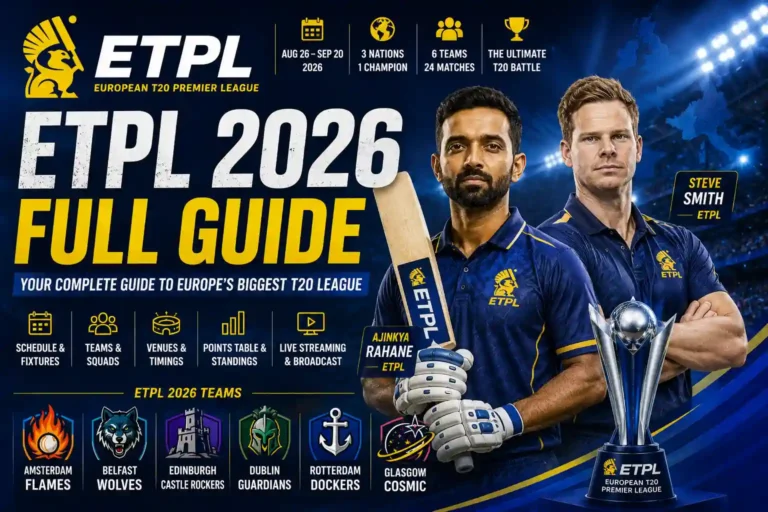
None of this means England and Wales are absent from the league entirely — just absent as franchise-owning nations. Individual English and Welsh players can and do turn out for ETPL teams as overseas signings, the same way an Australian or South African star would. England’s Liam Livingstone is part of the marquee player pool for the 2026 season, playing alongside the likes of Steve Smith, Ajinkya Rahane, and Ravichandran Ashwin. So the players aren’t missing — it’s specifically the franchise structure, the “home nation,” that’s reserved for the league’s three founding boards.
Could That Change Later?
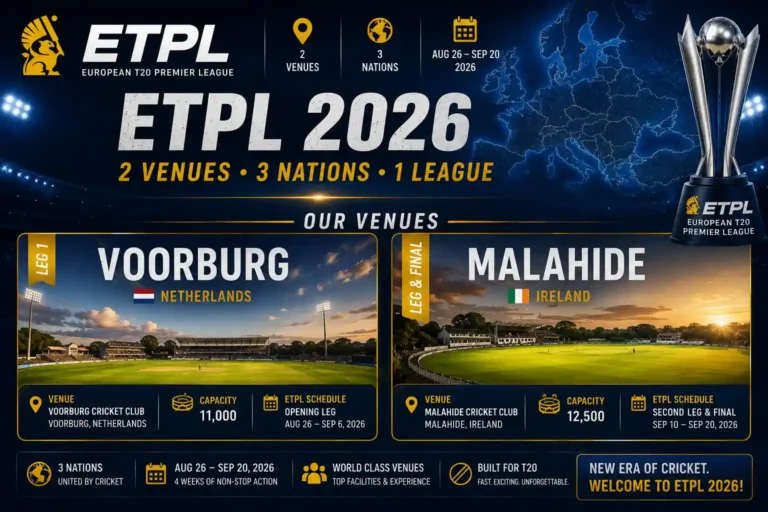
The tournament is designed to run annually, and nothing about the current three-board structure is written in stone for all time. Scotland-based sides don’t even host matches on home soil in this first season — everything is split between the Netherlands and Ireland — which is itself a sign the league is still finding its footing before expanding further. Whether England, Wales, or other European cricket boards join a future edition is an open question, but for the inaugural 2026 season, the ETPL is deliberately built around Ireland, Scotland, and the Netherlands and nobody else.
For the current franchise list and squads, see the ETPL teams page, and track the season as it unfolds on the ETPL points table.